Source: Gregersen, Mitter & Svejstrup, Nature Protocols (2019), https://doi.org/10.1038/s41596-019-0262-3
This file keeps only the actionable materials/reagents/procedure/troubleshooting/timing content from the original paper (narrative/background sections removed).
Fig. 1b — DRB/TTchem-seq: 3.5 h DRB incubation synchronizes RNAPII near the TSS, then release + 10 min 4SU pulse at each of 10/20/30/40 min after release.
图 1b — DRB/TTchem-seq:DRB 孵育 3.5 h 使 RNAPII 同步聚集在 TSS 附近,随后释放并在释放后 10/20/30/40 min 各做 10 min 的 4SU 脉冲标记。
Key limits to keep in mind
RNA fragmentation limits resolution to 25–500 nt fragments; increase base-hydrolysis time for smaller (higher-resolution) fragments. Size-exclusion clean-up excludes RNA <20 nt.
Longer 4SU pulse → more incorporated 4SU but more co-transcriptionally processed transcript; shorter pulse → more selective but too short a pulse gives poor library yield.
DRB/TTchem-seq elongation-rate analysis is only reliable for genes >60 kb (RNAPII wave has already moved 10–15 kb by 10 min post-release).
Typical yields: ~200–700 ng 4SU-RNA per 100 µg total RNA for standard TTchem-seq; ~50–100 ng for DRB/TTchem-seq.
Sequence to ~50–70 million reads/sample (single-end sufficient; paired-end needed only for co-transcriptional splicing info).
重要提示(务必牢记)
RNA 片段化后分辨率受限于 25–500 nt 的片段长度;若需更小片段(更高分辨率),延长碱水解时间。柱纯化会排除 <20 nt 的 RNA。
CRITICAL Use RNase-free, molecular biology–grade materials and water for all solutions.
4SU (0.5 M) stock: 1 g 4SU (MW 260.27) in 7.68 mL DMSO (or 250 mg in 1.92 mL). Aliquot 100–500 µL. Store −20 °C, dark, ≤12 months.
4TU (1 M) stock: 1 g 4TU (MW 128.15) in 7.80 mL water. Aliquot 500 µL. Store −20 °C, dark, ≤12 months.
DRB (100 mM) stock (DRB/TTchem-seq only): 10 mg DRB (MW 319.14) in 313.3 µL DMSO. Aliquot 50 µL. Store −20 °C, dark, ≤12 months.
EDTA (0.5 M, pH 8.0): 186.12 g EDTA in 700 mL RNase-free water, pH to 8.0 with NaOH, top up to 1 L. RT, ≤12 months.
Tris-HCl (1 M), pH 6.8: 157.6 g Trizma-HCl in 700 mL water, pH to 6.8 with NaOH, top up to 1 L. RT, ≤12 months.
Tris-HCl (1 M), pH 7.4: same as above but pH to 7.4. RT, ≤12 months.
NaCl (5 M): 292 g NaCl to 1 L water. RT, ≤12 months.
Enzymatic yeast RNA extraction buffer: 0.8 M sorbitol, 0.1 M EDTA, 0.1% (vol/vol) 2-mercaptoethanol + lyticase to 200 U/mL (add fresh). For 100 mL without lyticase: 14.57 g sorbitol + 2.92 g EDTA in water to 99.9 mL + 100 µL 2-mercaptoethanol; RT ≤12 months. Add lyticase fresh (200 U/mL) just before use.
Biotin buffer: 833 mM Tris-HCl pH 7.4, 83.3 mM EDTA. 10 mL = 8.33 mL 1 M Tris-HCl pH 7.4 + 1.67 mL 0.5 M EDTA. RT, ≤12 months.
Dot/slot blot blocking buffer: 10% (wt/vol) SDS, 1 mM EDTA in PBS. 500 mL = 50 g SDS + 1 mL 0.5 M EDTA + PBS to 500 mL. RT, ≤12 months.
Dot/slot blot wash buffer I: 1% (wt/vol) SDS in PBS. 500 mL = 5 g SDS + PBS to 500 mL. RT, ≤12 months.
Dot/slot blot wash buffer II: 0.1% (wt/vol) SDS in PBS. 500 mL = 0.5 g SDS + PBS to 500 mL. RT, ≤12 months.
Dot/slot blot staining buffer: 0.5 M sodium acetate, 0.5% (wt/vol) methylene blue. 500 mL = 20.51 g sodium acetate + 250 mg methylene blue in water to 500 mL. RT, ≤12 months.
Pull-down wash buffer: 100 mM Tris-HCl pH 7.4, 10 mM EDTA, 1 M NaCl, 0.1% (vol/vol) Tween 20. 100 mL = 10 mL 1 M Tris-HCl pH7.4 + 2 mL 0.5 M EDTA + 20 mL 5 M NaCl + 100 µL Tween 20 + water to 100 mL. RT, ≤12 months.
Elution buffer: 100 mM DTT, freshly dissolved in RNase-free water (154 mg per 10 mL). Prepare immediately before use.
试剂配制
关键:所有溶液均须使用无 RNase、分子生物学级材料和水。
4SU(0.5 M)母液:1 g 4SU(分子量 260.27)溶于 7.68 mL DMSO(或 250 mg 溶于 1.92 mL)。分装 100–500 µL/管。−20 °C 避光保存,≤12 个月。
4TU(1 M)母液:1 g 4TU(分子量 128.15)溶于 7.80 mL 水。分装 500 µL/管。−20 °C 避光保存,≤12 个月。
EDTA(0.5 M,pH 8.0):186.12 g EDTA 溶于 700 mL 无 RNase 水,用 NaOH 调 pH 至 8.0,补水定容至 1 L。室温(RT)保存,≤12 个月。
Tris-HCl(1 M),pH 6.8:157.6 g Trizma-HCl 溶于 700 mL 水,用 NaOH 调 pH 至 6.8,补水定容至 1 L。RT,≤12 个月。
Tris-HCl(1 M),pH 7.4:同上,调 pH 至 7.4。RT,≤12 个月。
NaCl(5 M):292 g NaCl 定容至 1 L 水。RT,≤12 个月。
酵母 RNA 酶解提取缓冲液:0.8 M sorbitol、0.1 M EDTA、0.1%(vol/vol)2-mercaptoethanol + lyticase 至 200 U/mL(现配)。不含 lyticase 的 100 mL 配方:14.57 g sorbitol + 2.92 g EDTA 溶于水至 99.9 mL + 100 µL 2-mercaptoethanol;RT ≤12 个月保存。使用前现加 lyticase(200 U/mL)。
Biotin buffer:833 mM Tris-HCl pH 7.4,83.3 mM EDTA。10 mL = 8.33 mL 1 M Tris-HCl pH 7.4 + 1.67 mL 0.5 M EDTA。RT,≤12 个月。
Dot/slot blot 封闭液:10%(wt/vol)SDS,1 mM EDTA,溶于 PBS。500 mL = 50 g SDS + 1 mL 0.5 M EDTA + PBS 定容至 500 mL。RT,≤12 个月。
Dot/slot blot 洗涤液 I:1%(wt/vol)SDS 溶于 PBS。500 mL = 5 g SDS + PBS 定容至 500 mL。RT,≤12 个月。
Dot/slot blot 洗涤液 II:0.1%(wt/vol)SDS 溶于 PBS。500 mL = 0.5 g SDS + PBS 定容至 500 mL。RT,≤12 个月。
Dot/slot blot 染色液:0.5 M 醋酸钠,0.5%(wt/vol)亚甲基蓝。500 mL = 20.51 g 醋酸钠 + 250 mg 亚甲基蓝溶于水定容至 500 mL。RT,≤12 个月。
Pull-down 洗涤液:100 mM Tris-HCl pH 7.4,10 mM EDTA,1 M NaCl,0.1%(vol/vol)Tween 20。100 mL = 10 mL 1 M Tris-HCl pH7.4 + 2 mL 0.5 M EDTA + 20 mL 5 M NaCl + 100 µL Tween 20 + 水定容至 100 mL。RT,≤12 个月。
洗脱液(Elution buffer):100 mM DTT,现用无 RNase 水配制(每 10 mL 用 154 mg)。须现配现用。
Procedure
实验步骤
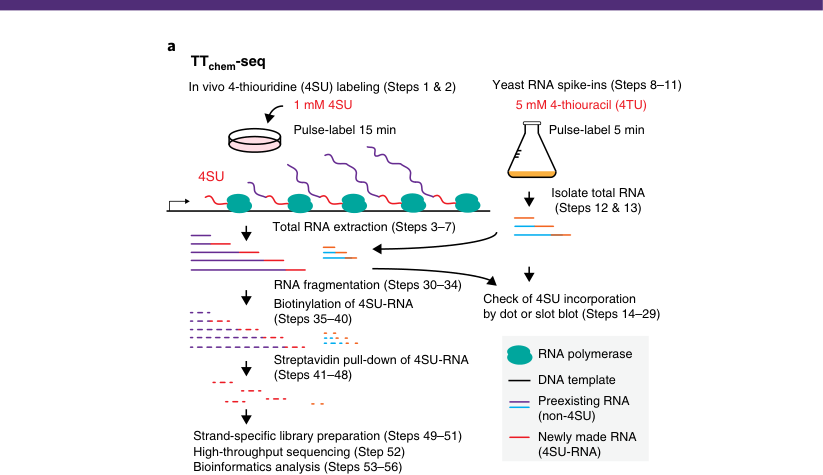
A. Cell culture and 4SU labeling — Timing 24 h
Seed cells at 50% confluency in a 10-cm dish, one dish per time point/sample/control; grow overnight (e.g., HEK293: high-glucose DMEM + 10% FBS + 2 mM L-glutamine).
- CRITICAL STEP Always count cells to seed the same number each time (e.g., 2×10⁶ HEK293 cells/10-cm plate → ~50% confluency at seeding, ~70–80% next day; adjust per cell line).
- Choose option A (TTchem-seq) or option B (DRB/TTchem-seq).
(A) TTchem-seq — 4SU only
- (i) Add 4SU directly to medium to 1 mM final (e.g., 20 µL of 0.5 M 4SU into 10 mL medium), mix, incubate 15 min.
- CRITICAL STEP Keep 4SU exposure time identical across all samples/controls. When processing many samples, stagger 4SU addition by 1 min per dish so each can be stopped at exactly the same elapsed time.
(B) DRB/TTchem-seq — DRB + 4SU
- (i) Treat with 100 µM DRB for 3.5 h per time point (typically 10, 20, 30, 40 min after release); e.g. 10 µL of 100 mM DRB stock into 10 mL medium.
- CRITICAL STEP Stagger DRB treatment/release times across samples to keep timing exact.
- (ii) Release DRB with 3× washes of 10 mL pre-warmed (37 °C) PBS, then add pre-warmed fresh medium:
- 10-min release: add fresh medium + 1 mM 4SU immediately after washes; label 10 min.
- 20-min release: fresh medium without 4SU for 10 min, then add 4SU to 1 mM for the last 10 min.
- 30-min release: fresh medium without 4SU for 20 min, then 4SU for the last 10 min.
- 40-min release: fresh medium without 4SU for 30 min, then 4SU for the last 10 min.
- CRITICAL STEP Keep the 4SU pulse exactly 10 min for every sample/control; stagger 4SU additions when processing multiple samples in parallel.
Aspirate medium, stop labeling by adding 1 mL TRIzol per 10-cm dish (scale up for bigger dishes). Scrape cells with a cell lifter into a microcentrifuge tube.
- ! CAUTION TRIzol is toxic — work in a fume hood; aspirate medium then quickly move the dish to the hood before adding TRIzol.
- PAUSE POINT Cells in TRIzol: RT up to 30 min while collecting other samples, or −80 °C up to 1 year.
Add 200 µL chloroform per 1 mL TRIzol–cell mixture, shake 30 s, spin 12,000g, 15 min, 4 °C.
- ! CAUTION fume hood. CRITICAL STEP TRIzol/chloroform + isopropanol precipitation is preferred over column kits (not limited to ~100 µg binding capacity).
Spin phase-lock-gel tubes 12,000g, 20–30 s, RT to settle gel. Transfer upper aqueous phase from Step 3 onto the gel. Add equal volume chloroform/isoamyl alcohol (24:1). Shake, spin 12,000g, 5 min, 4 °C.
- ! CAUTION fume hood. CRITICAL STEP phase-lock-gel tubes prevent organic-phase carryover.
Transfer upper aqueous phase to a new tube, add 1.1 vol isopropanol, RT 20 min, spin 12,000g, 20 min, 4 °C to pellet RNA.
- CRITICAL STEP Do not transfer any organic phase.
Wash pellet in 750 µL 85% ethanol (don't disturb pellet), spin 7,500g, 5 min, 4 °C.
Discard ethanol, air-dry pellet, resuspend in 50–100 µL RNase-free water. Measure concentration (Qubit RNA BR, expect >1 µg/µL) and check integrity (Bioanalyzer, Agilent RNA 6000 Nano Kit).
- CRITICAL STEP Remove residual ethanol thoroughly (P1000 → quick spin 1,000g/RT/5s → P20 ultra-thin tip); air-dry until pellet edges look slightly transparent (~2–3 min) before resuspending.
- CRITICAL STEP Use Qubit, not NanoDrop (NanoDrop overestimates RNA concentration) — accurate total-RNA quantitation is required for correct yeast spike-in dosing. (? TROUBLESHOOTING, see table)
- PAUSE POINT Mammalian total 4SU-RNA: −80 °C up to 1 year.
! CAUTION fume hood. CRITICAL STEP Use phenol/chloroform, not column kits — kit buffers often contain reducing agents that cleave the biotin disulfide bond.
Precipitate with 1/10 vol 5 M NaCl + 1.1 vol isopropanol; invert, RT 10 min.
Spin 20,000g, 20 min, 4 °C; discard supernatant.
Wash pellet in 500 µL 85% ethanol, spin 20,000g, 5 min, 4 °C.
CRITICAL STEP Remove residual ethanol thoroughly as in Step 7; air-dry ~2–3 min before resuspending.
Reconstitute in 10 µL RNase-free water.
Soak Hybond-N membrane + Whatman paper in RNase-free water; assemble in dot/slot blot apparatus; connect vacuum.
CRITICAL STEP Pre-wet membrane/paper, ensure a tight seal to prevent well-to-well diffusion.
Load 10 µL sample (2–10 µg biotinylated RNA) per well.
CRITICAL STEP Optional 0.001% bromophenol blue helps visualize loading.
Turn off vacuum, disassemble, mark membrane orientation (cut a corner).
UV-crosslink at 0.2 J/cm² (254 nm).
CRITICAL STEP Keep UV dose constant, not exposure time (bulb output varies with warm-up).
Block in dot/slot blot blocking buffer, 20 min, RT.
CRITICAL STEP Don't let blocking buffer get cold (SDS precipitates below RT).
Probe with 1:50,000 HRP-streptavidin (1 mg/mL) in blocking buffer, 15 min, RT.
Wash: 2× blocking buffer (10 min), 2× wash buffer I (10 min), 2× wash buffer II (10 min).
Detect with ECL (dilute 1:5 if signal too strong).
CRITICAL STEP Yeast (4TU) signal is ~100× the mammalian (4SU) signal. (? TROUBLESHOOTING, see table)
Stain for RNA loading with staining buffer, 10 min RT; de-stain with water washes (last wash can be overnight); image on a scanner.
CRITICAL STEP Wash enough to remove background but not so much that RNA stain is lost.
Mix 100 µg 4SU-labeled mammalian RNA (Step 7) + 1 µg yeast 4TU-RNA (Step 13) in 100 µL RNase-free water (on ice) per sample. Add 20 µL 1 M NaOH, incubate 20 min on ice.
CRITICAL STEP Same yeast spike-in amount in every sample; dilute yeast RNA to avoid <2 µL pipetting.
CRITICAL STEP Spike-ins are added to extracted RNA (not to the TRIzol–cell mixture, since cells can't be counted post-TRIzol); if per-cell RNA content is expected to change, base spike-in dosing on parallel cell counts instead.
CRITICAL STEP Ice incubation time controls fragment size; extend to 30–40 min for shorter fragments.
Stop fragmentation with 80 µL 1 M Tris pH 6.8; proceed immediately to Micro Bio-Spin P-30 clean-up.
CRITICAL STEP Tris alone doesn't fully stop fragmentation — go straight to the columns.
Prepare Micro Bio-Spin P-30 columns: invert to resuspend gel, snap tips, drain packing buffer by gravity (~2 min), then spin 1,000g, 2 min, RT to remove residual buffer.
Elute with 100 µL elution buffer (RT); repeat after 5 min with another 100 µL; pool eluates.
CRITICAL STEP Prepare elution buffer immediately before use.
Clean up/concentrate eluate(s) with RNeasy MinElute: for a 200-µL sample, add 700 µL RLT buffer + 1,050 µL 100% ethanol, apply over 3 rounds (700 µL onto column, spin 11,000g/30s/RT, discard flow-through, repeat), then follow Qiagen protocol. Elute in 15 µL RNase-free water.
CRITICAL STEP The extra ethanol (1.5× vs. standard protocol) is required to retain <200-nt fragments, which the standard MinElute protocol would discard.
Check size on Bioanalyzer (Agilent RNA 6000 Pico Kit) — should match Step-34 fragment size. Measure concentration with Qubit RNA HS Assay Kit.
CRITICAL STEP Use Qubit, not NanoDrop. Typical yield: 200–700 ng 4SU-RNA per 100 µg total RNA (TTchem-seq); ~50–100 ng (DRB/TTchem-seq, due to RNAPII synchronization near TSS). (? TROUBLESHOOTING, see table)
PAUSE POINT −80 °C, up to a few weeks before library prep.
H. Strand-specific library preparation — Timing 2 d
Prepare libraries from purified 4SU-RNA using any strand-specific, Illumina-compatible kit (e.g., KAPA Stranded RNA-Seq Library Prep Kit or KAPA RNA HyperPrep Kit + KAPA Dual-Indexed Adapter Kit). No further RNA fragmentation is needed — follow the kit's "degraded RNA" protocol: 30 s at 65 °C with 2× fragment/prime/elute buffer (KAPA Stranded) or 1 min at 65 °C (KAPA RNA HyperPrep), before first-strand synthesis.
CRITICAL STEP Best coverage from >50 ng 4SU-RNA input; typically start from ~100–300 ng (as little as 10 ng can work).
Follow the kit's remaining steps. Optional test PCR to set cycle number: pause after 6 cycles, remove 10–20% aliquot, continue removing an aliquot every 2 cycles; run on 6% TBE gel with SYBR Gold; pick "two cycles before saturation" (typically 6–9 cycles total).
QC the final library for concentration and size (typically 280–300 nt peak with KAPA kits). PAUSE POINT −20 °C, several months.
对最终文库进行常规质控,确定 DNA 浓度并确认片段大小(取决于 RNA 片段大小及试剂盒接头长度;用 KAPA 试剂盒典型峰值为 280–300 nt)。暂停点 −20 °C 可保存数月。
I. High-throughput sequencing — Timing 16 h
Sequence single-end or paired-end, ~50–70 million reads/sample (HiSeq 2500/4000 or equivalent).
CRITICAL STEP 3–4 samples/lane on HiSeq 4000 for high-resolution single-gene profiles; more multiplexing (aiming ~30 million reads/sample) is OK if only metagene profiles are needed.
I. 高通量测序 —— 用时 16 h
以单端或双端模式测序(选择依据见原文 Introduction),每样本约 50–70 M reads(HiSeq 2500、HiSeq 4000 或其他兼容平台)。
关键步骤 所需测序深度取决于下游分析和生物学问题。为获得高分辨率的单基因图谱(即使是低表达蛋白编码基因和 lncRNA),通常每条 lane 上样 3–4 个样本(HiSeq 4000)。若只需 metagene 图谱,可增加多重上样量,目标约 30 M reads/样本。
J. Bioinformatics analysis — Timing 2–5 d
QC with FastQC (or similar).
CRITICAL STEP At 50–70 million reads/sample, expect >45–65 million mapped reads after trimming/alignment. Lower depth (e.g. 30 million) may work but is risky for single-gene conclusions, especially DRB/TTchem-seq at later time points.
Alignment: build STAR genome indices for target (e.g. GRCh38) and spike-in (sacCer3) genomes; align with --quantMode GeneCounts (adjust for single-/paired-end); sort/index/mark-duplicates with SAMtools or Picard.
Scale factors: build a yeast gene-count matrix from spike-in alignments (STAR *.ReadsPerGene.out.tab, or htseq-count / GenomicAlignments::summarizeOverlaps); pass to DESeq2's estimateSizeFactors. If counts aren't applicable, use total unique mapped reads instead.
BigWig files: split target BAM into forward/reverse strand with SAMtools; convert each to a scaled BigWig with deepTools bamCoverage --scaleFactor.
(A) Metagene profiles (TTchem-seq): (i) build sense/antisense gene-body and TSS meta-profiles with ngs.plot –SS; for paired data, first restrict to mate-1 reads with SAMtools.
(i) Extended TSS meta-profiles: using R GRanges + GTF, build TSS-region intervals (−2 kb : +120 kb) for non-overlapping, 60–300 kb protein-coding genes (Ensembl gene view) on standard chromosomes; compute base-pair read-depth with bamsignals::bamCoverage; scale to RPM; take a 0.01-trimmed mean per bp.
(ii) Wave peak calling, metagene: fit smooth.spline (spar = 0.9) to each meta-profile; call the wave peak as the spline maximum; require peaks to advance monotonically with time.
(iii) Wave peak calling, single gene: same, per gene; filter out genes with total coverage <100 over the region, missing values, non-advancing peaks, or (optionally) a first-time-point peak <2 kb. Scripts: DRB-TTseq.R / DRB-TTseq.Rmd on https://github.com/crickbabs/DRB_TT-seq/releases/tag/v1.2
(iv) Elongation rate: linear fit of wave-peak position vs. time (kb/min); optionally include an assumed t=0, position=0 point.
CRITICAL STEP Reference scripts/data: https://github.com/crickbabs/DRB_TT-seq (release v1.2 zip includes code + data).
J. 生信分析 —— 用时 2–5 d
用 FastQC(或类似软件)评估文库质量。
关键步骤 每样本测序深度为 50–70 M reads 时,经接头修剪和比对后预期获得 >45–65 M 有效比对 reads。较低深度(如 30 M)也可能可用,但基于单基因结论会更不可靠,尤其在 DRB/TTchem-seq 释放后期时间点信号更分散的情况下。
比对:为目标基因组(如 Homo sapiens GRCh38)和 spike-in 基因组(S. cerevisiae sacCer3)构建 STAR 基因组索引(结合现有基因注释);用 STAR 加 --quantMode GeneCounts 参数进行比对(根据单端/双端调整);用 SAMtools 或 Picard 对生成的 BAM 文件排序、建索引、标记重复。
Use clean tips/fresh RNase-free buffers; wear gloves; clean pipettes with RNaseZAP
28
No dot/slot blot signal
Lack of 4SU incorporation
Confirm 4SU concentration/storage (light-sensitive); use 200 µM 4SU overnight or 5-min 5 mM 4TU yeast labeling as positive control (~100× stronger signal)
28
No dot/slot blot signal
No biotinylation of 4SU residues
If the positive control also fails, biotinylation likely failed — remake MTSEA biotin-XX linker, store at −80 °C protected from light
48
No/low 4SU-RNA after pull-down
Insufficient 4SU incorporation
Check incorporation by dot/slot blot before pull-down; scale up starting material if yield <50 ng
48
No/low 4SU-RNA after pull-down
Inactive biotin linker
Aliquot MTSEA biotin-XX, store dark at −80 °C, use within a year
48
No/low 4SU-RNA after pull-down
Poor elution
Use freshly prepared elution buffer
—
RNA fragments too short after hydrolysis
Over-fragmentation
Perform hydrolysis on ice; add 1 M Tris pH 6.8 immediately after the 20-min incubation and proceed straight to Micro Bio-Spin P-30 clean-up
—
High background in non-4SU control
Pull-down not stringent enough
Pre-heat pull-down wash buffer to 55 °C (keep pre-heated aliquots); can add 2 washes in 8 M guanidinium chloride + 3 washes in TE (10 mM Tris pH 7.4, 1 mM EDTA) at 55 °C
若阳性对照(见上)也无信号,很可能是生物素化反应失败——重新配制 MTSEA biotin-XX linker,−80 °C 避光保存
48
Streptavidin 富集后无或极少 4SU-RNA
新合成 RNA 中 4SU 掺入不足
4SU 掺入效率因细胞系而异,应在做生物素标记和富集前先用 dot/slot blot 确认掺入效率是否足够;若产量仍过低(<50 ng),可能需要增加起始材料量
48
Streptavidin 富集后无或极少 4SU-RNA
生物素 linker 失活
分装 MTSEA biotin-XX linker,避光 −80 °C 保存,一年内用完
48
Streptavidin 富集后无或极少 4SU-RNA
4SU-RNA 从磁珠洗脱不佳
使用新鲜配制的洗脱液进行 4SU-RNA 洗脱
—
水解后 RNA 片段过短
RNA 过度片段化
确保受控 RNA 碱水解在冰上进行;20 min 孵育结束后立即加入 1 M Tris pH 6.8,并立即进行 Micro Bio-Spin P-30 柱纯化
—
非 4SU 对照中本底过高
4SU-RNA 纯化的严格程度不够
确保 pull-down 洗涤液预热至 55 °C(提前准备小份预热液,每次洗涤各用一份);也可参考文献做法,在 1 M NaCl pull-down 洗涤液的两次洗涤基础上,增加两次 8 M 盐酸胍变性缓冲液洗涤,再于 55 °C 用 TE 缓冲液(10 mM Tris pH 7.4,1 mM EDTA)洗涤三次
Timing
Stage
Steps
Time
Cell culture and 4SU incorporation
1–2
24 h
Total RNA extraction
3–7
4–5 h
Yeast 4SU-RNA spike-in prep
8–13
24 h
Assessment of 4SU incorporation (dot/slot blot)
14–29
7 h
RNA fragmentation
30–34
1 h
Biotinylation of 4SU-RNA
35–40
2 h
Streptavidin pull-down of 4SU-RNA
41–48
2–3 h
Strand-specific library preparation
49–51
2 d
High-throughput sequencing
52
16 h
Bioinformatics analysis
53–56
2–5 d
时间安排
阶段
步骤
用时
细胞培养与 4SU 标记
1–2
24 h
总 RNA 提取
3–7
4–5 h
酵母 4SU-RNA spike-in 制备
8–13
24 h
dot/slot blot 检测 4SU 掺入效率
14–29
7 h
RNA 片段化
30–34
1 h
4SU-RNA 生物素化
35–40
2 h
Streptavidin 富集 4SU-RNA
41–48
2–3 h
链特异性建库
49–51
2 d
高通量测序
52
16 h
生信分析
53–56
2–5 d
Reference data
All sequencing data: GEO accession GSE121826
Analysis code: https://github.com/crickbabs/DRB_TT-seq and https://github.com/crickbabs/DRB_TT-seq/releases/tag/v1.2
Source: Gregersen, Mitter & Svejstrup, Nature Protocols (2019), https://doi.org/10.1038/s41596-019-0262-3
This file keeps only the actionable materials/reagents/procedure/troubleshooting/timing content from the original paper (narrative/background sections removed).
Fig. 1b — DRB/TTchem-seq: 3.5 h DRB incubation synchronizes RNAPII near the TSS, then release + 10 min 4SU pulse at each of 10/20/30/40 min after release.
重要提示(务必牢记)
RNA 片段化后分辨率受限于 25–500 nt 的片段长度;若需更小片段(更高分辨率),延长碱水解时间。柱纯化会排除 <20 nt 的 RNA。
测序深度建议每样本 ~50–70 M reads(单端已足够;双端仅在需要研究共转录剪接时才需要)。
Key limits to keep in mind
RNA fragmentation limits resolution to 25–500 nt fragments; increase base-hydrolysis time for smaller (higher-resolution) fragments. Size-exclusion clean-up excludes RNA <20 nt.
Longer 4SU pulse → more incorporated 4SU but more co-transcriptionally processed transcript; shorter pulse → more selective but too short a pulse gives poor library yield.
DRB/TTchem-seq elongation-rate analysis is only reliable for genes >60 kb (RNAPII wave has already moved 10–15 kb by 10 min post-release).
Typical yields: ~200–700 ng 4SU-RNA per 100 µg total RNA for standard TTchem-seq; ~50–100 ng for DRB/TTchem-seq.
Sequence to ~50–70 million reads/sample (single-end sufficient; paired-end needed only for co-transcriptional splicing info).
材料
Materials
生物材料
S. cerevisiae BY4741(用作 spike-in;Euroscarf, cat. no. Y00000)
EDTA(0.5 M,pH 8.0):186.12 g EDTA 溶于 700 mL 无 RNase 水,用 NaOH 调 pH 至 8.0,补水定容至 1 L。室温(RT)保存,≤12 个月。
Tris-HCl(1 M),pH 6.8:157.6 g Trizma-HCl 溶于 700 mL 水,用 NaOH 调 pH 至 6.8,补水定容至 1 L。RT,≤12 个月。
Tris-HCl(1 M),pH 7.4:同上,调 pH 至 7.4。RT,≤12 个月。
NaCl(5 M):292 g NaCl 定容至 1 L 水。RT,≤12 个月。
酵母 RNA 酶解提取缓冲液:0.8 M sorbitol、0.1 M EDTA、0.1%(vol/vol)2-mercaptoethanol + lyticase 至 200 U/mL(现配)。不含 lyticase 的 100 mL 配方:14.57 g sorbitol + 2.92 g EDTA 溶于水至 99.9 mL + 100 µL 2-mercaptoethanol;RT ≤12 个月保存。使用前现加 lyticase(200 U/mL)。
Biotin buffer:833 mM Tris-HCl pH 7.4,83.3 mM EDTA。10 mL = 8.33 mL 1 M Tris-HCl pH 7.4 + 1.67 mL 0.5 M EDTA。RT,≤12 个月。
Dot/slot blot 封闭液:10%(wt/vol)SDS,1 mM EDTA,溶于 PBS。500 mL = 50 g SDS + 1 mL 0.5 M EDTA + PBS 定容至 500 mL。RT,≤12 个月。
Dot/slot blot 洗涤液 I:1%(wt/vol)SDS 溶于 PBS。500 mL = 5 g SDS + PBS 定容至 500 mL。RT,≤12 个月。
Dot/slot blot 洗涤液 II:0.1%(wt/vol)SDS 溶于 PBS。500 mL = 0.5 g SDS + PBS 定容至 500 mL。RT,≤12 个月。
Dot/slot blot 染色液:0.5 M 醋酸钠,0.5%(wt/vol)亚甲基蓝。500 mL = 20.51 g 醋酸钠 + 250 mg 亚甲基蓝溶于水定容至 500 mL。RT,≤12 个月。
Pull-down 洗涤液:100 mM Tris-HCl pH 7.4,10 mM EDTA,1 M NaCl,0.1%(vol/vol)Tween 20。100 mL = 10 mL 1 M Tris-HCl pH7.4 + 2 mL 0.5 M EDTA + 20 mL 5 M NaCl + 100 µL Tween 20 + 水定容至 100 mL。RT,≤12 个月。
洗脱液(Elution buffer):100 mM DTT,现用无 RNase 水配制(每 10 mL 用 154 mg)。须现配现用。
Reagent setup
CRITICAL Use RNase-free, molecular biology–grade materials and water for all solutions.
4SU (0.5 M) stock: 1 g 4SU (MW 260.27) in 7.68 mL DMSO (or 250 mg in 1.92 mL). Aliquot 100–500 µL. Store −20 °C, dark, ≤12 months.
4TU (1 M) stock: 1 g 4TU (MW 128.15) in 7.80 mL water. Aliquot 500 µL. Store −20 °C, dark, ≤12 months.
DRB (100 mM) stock (DRB/TTchem-seq only): 10 mg DRB (MW 319.14) in 313.3 µL DMSO. Aliquot 50 µL. Store −20 °C, dark, ≤12 months.
EDTA (0.5 M, pH 8.0): 186.12 g EDTA in 700 mL RNase-free water, pH to 8.0 with NaOH, top up to 1 L. RT, ≤12 months.
Tris-HCl (1 M), pH 6.8: 157.6 g Trizma-HCl in 700 mL water, pH to 6.8 with NaOH, top up to 1 L. RT, ≤12 months.
Tris-HCl (1 M), pH 7.4: same as above but pH to 7.4. RT, ≤12 months.
NaCl (5 M): 292 g NaCl to 1 L water. RT, ≤12 months.
Enzymatic yeast RNA extraction buffer: 0.8 M sorbitol, 0.1 M EDTA, 0.1% (vol/vol) 2-mercaptoethanol + lyticase to 200 U/mL (add fresh). For 100 mL without lyticase: 14.57 g sorbitol + 2.92 g EDTA in water to 99.9 mL + 100 µL 2-mercaptoethanol; RT ≤12 months. Add lyticase fresh (200 U/mL) just before use.
Biotin buffer: 833 mM Tris-HCl pH 7.4, 83.3 mM EDTA. 10 mL = 8.33 mL 1 M Tris-HCl pH 7.4 + 1.67 mL 0.5 M EDTA. RT, ≤12 months.
Dot/slot blot blocking buffer: 10% (wt/vol) SDS, 1 mM EDTA in PBS. 500 mL = 50 g SDS + 1 mL 0.5 M EDTA + PBS to 500 mL. RT, ≤12 months.
Dot/slot blot wash buffer I: 1% (wt/vol) SDS in PBS. 500 mL = 5 g SDS + PBS to 500 mL. RT, ≤12 months.
Dot/slot blot wash buffer II: 0.1% (wt/vol) SDS in PBS. 500 mL = 0.5 g SDS + PBS to 500 mL. RT, ≤12 months.
Dot/slot blot staining buffer: 0.5 M sodium acetate, 0.5% (wt/vol) methylene blue. 500 mL = 20.51 g sodium acetate + 250 mg methylene blue in water to 500 mL. RT, ≤12 months.
Pull-down wash buffer: 100 mM Tris-HCl pH 7.4, 10 mM EDTA, 1 M NaCl, 0.1% (vol/vol) Tween 20. 100 mL = 10 mL 1 M Tris-HCl pH7.4 + 2 mL 0.5 M EDTA + 20 mL 5 M NaCl + 100 µL Tween 20 + water to 100 mL. RT, ≤12 months.
Elution buffer: 100 mM DTT, freshly dissolved in RNase-free water (154 mg per 10 mL). Prepare immediately before use.
Seed cells at 50% confluency in a 10-cm dish, one dish per time point/sample/control; grow overnight (e.g., HEK293: high-glucose DMEM + 10% FBS + 2 mM L-glutamine).
- CRITICAL STEP Always count cells to seed the same number each time (e.g., 2×10⁶ HEK293 cells/10-cm plate → ~50% confluency at seeding, ~70–80% next day; adjust per cell line).
- Choose option A (TTchem-seq) or option B (DRB/TTchem-seq).
(A) TTchem-seq — 4SU only
- (i) Add 4SU directly to medium to 1 mM final (e.g., 20 µL of 0.5 M 4SU into 10 mL medium), mix, incubate 15 min.
- CRITICAL STEP Keep 4SU exposure time identical across all samples/controls. When processing many samples, stagger 4SU addition by 1 min per dish so each can be stopped at exactly the same elapsed time.
(B) DRB/TTchem-seq — DRB + 4SU
- (i) Treat with 100 µM DRB for 3.5 h per time point (typically 10, 20, 30, 40 min after release); e.g. 10 µL of 100 mM DRB stock into 10 mL medium.
- CRITICAL STEP Stagger DRB treatment/release times across samples to keep timing exact.
- (ii) Release DRB with 3× washes of 10 mL pre-warmed (37 °C) PBS, then add pre-warmed fresh medium:
- 10-min release: add fresh medium + 1 mM 4SU immediately after washes; label 10 min.
- 20-min release: fresh medium without 4SU for 10 min, then add 4SU to 1 mM for the last 10 min.
- 30-min release: fresh medium without 4SU for 20 min, then 4SU for the last 10 min.
- 40-min release: fresh medium without 4SU for 30 min, then 4SU for the last 10 min.
- CRITICAL STEP Keep the 4SU pulse exactly 10 min for every sample/control; stagger 4SU additions when processing multiple samples in parallel.
Aspirate medium, stop labeling by adding 1 mL TRIzol per 10-cm dish (scale up for bigger dishes). Scrape cells with a cell lifter into a microcentrifuge tube.
- ! CAUTION TRIzol is toxic — work in a fume hood; aspirate medium then quickly move the dish to the hood before adding TRIzol.
- PAUSE POINT Cells in TRIzol: RT up to 30 min while collecting other samples, or −80 °C up to 1 year.
Add 200 µL chloroform per 1 mL TRIzol–cell mixture, shake 30 s, spin 12,000g, 15 min, 4 °C.
- ! CAUTION fume hood. CRITICAL STEP TRIzol/chloroform + isopropanol precipitation is preferred over column kits (not limited to ~100 µg binding capacity).
Spin phase-lock-gel tubes 12,000g, 20–30 s, RT to settle gel. Transfer upper aqueous phase from Step 3 onto the gel. Add equal volume chloroform/isoamyl alcohol (24:1). Shake, spin 12,000g, 5 min, 4 °C.
- ! CAUTION fume hood. CRITICAL STEP phase-lock-gel tubes prevent organic-phase carryover.
Transfer upper aqueous phase to a new tube, add 1.1 vol isopropanol, RT 20 min, spin 12,000g, 20 min, 4 °C to pellet RNA.
- CRITICAL STEP Do not transfer any organic phase.
Wash pellet in 750 µL 85% ethanol (don't disturb pellet), spin 7,500g, 5 min, 4 °C.
Discard ethanol, air-dry pellet, resuspend in 50–100 µL RNase-free water. Measure concentration (Qubit RNA BR, expect >1 µg/µL) and check integrity (Bioanalyzer, Agilent RNA 6000 Nano Kit).
- CRITICAL STEP Remove residual ethanol thoroughly (P1000 → quick spin 1,000g/RT/5s → P20 ultra-thin tip); air-dry until pellet edges look slightly transparent (~2–3 min) before resuspending.
- CRITICAL STEP Use Qubit, not NanoDrop (NanoDrop overestimates RNA concentration) — accurate total-RNA quantitation is required for correct yeast spike-in dosing. (? TROUBLESHOOTING, see table)
- PAUSE POINT Mammalian total 4SU-RNA: −80 °C up to 1 year.
C. 酵母 4SU-RNA spike-in 制备 —— 用时 24 h
将 S. cerevisiae BY4741 接种于 5 mL YPD(含 2% glucose)中,30 °C 摇床过夜(ON)培养预培养物。
将酵母培养物稀释至 OD600 = 0.1(50 mL 培养体系),30 °C 培养至 OD600 = 0.8(对数中期;通常需 5–7 h)。
加入 4TU 至终浓度 5 mM 进行标记(例如 250 µL 1 M 4TU 母液加入 50 mL 培养液),30 °C 标记 5 min。500g、5 min、4 °C 离心收集细胞。
! CAUTION fume hood. CRITICAL STEP Use phenol/chloroform, not column kits — kit buffers often contain reducing agents that cleave the biotin disulfide bond.
Precipitate with 1/10 vol 5 M NaCl + 1.1 vol isopropanol; invert, RT 10 min.
Spin 20,000g, 20 min, 4 °C; discard supernatant.
Wash pellet in 500 µL 85% ethanol, spin 20,000g, 5 min, 4 °C.
CRITICAL STEP Remove residual ethanol thoroughly as in Step 7; air-dry ~2–3 min before resuspending.
Reconstitute in 10 µL RNase-free water.
Soak Hybond-N membrane + Whatman paper in RNase-free water; assemble in dot/slot blot apparatus; connect vacuum.
CRITICAL STEP Pre-wet membrane/paper, ensure a tight seal to prevent well-to-well diffusion.
Load 10 µL sample (2–10 µg biotinylated RNA) per well.
CRITICAL STEP Optional 0.001% bromophenol blue helps visualize loading.
Turn off vacuum, disassemble, mark membrane orientation (cut a corner).
UV-crosslink at 0.2 J/cm² (254 nm).
CRITICAL STEP Keep UV dose constant, not exposure time (bulb output varies with warm-up).
Block in dot/slot blot blocking buffer, 20 min, RT.
CRITICAL STEP Don't let blocking buffer get cold (SDS precipitates below RT).
Probe with 1:50,000 HRP-streptavidin (1 mg/mL) in blocking buffer, 15 min, RT.
Wash: 2× blocking buffer (10 min), 2× wash buffer I (10 min), 2× wash buffer II (10 min).
Detect with ECL (dilute 1:5 if signal too strong).
CRITICAL STEP Yeast (4TU) signal is ~100× the mammalian (4SU) signal. (? TROUBLESHOOTING, see table)
Stain for RNA loading with staining buffer, 10 min RT; de-stain with water washes (last wash can be overnight); image on a scanner.
CRITICAL STEP Wash enough to remove background but not so much that RNA stain is lost.
用新柱重复步骤 32–33 纯化流程(取步骤 33 全部洗脱液上样);收集最终流出液,即 Tris 缓冲液中的片段化 RNA。
关键步骤 须进行两轮纯化以确保 RNA 溶液恢复中性 pH,防止继续片段化。
暂停点 可短期置于冰上(数小时),或 −80 °C 保存最长 1 年。
E. RNA fragmentation — Timing 1 h
Mix 100 µg 4SU-labeled mammalian RNA (Step 7) + 1 µg yeast 4TU-RNA (Step 13) in 100 µL RNase-free water (on ice) per sample. Add 20 µL 1 M NaOH, incubate 20 min on ice.
CRITICAL STEP Same yeast spike-in amount in every sample; dilute yeast RNA to avoid <2 µL pipetting.
CRITICAL STEP Spike-ins are added to extracted RNA (not to the TRIzol–cell mixture, since cells can't be counted post-TRIzol); if per-cell RNA content is expected to change, base spike-in dosing on parallel cell counts instead.
CRITICAL STEP Ice incubation time controls fragment size; extend to 30–40 min for shorter fragments.
Stop fragmentation with 80 µL 1 M Tris pH 6.8; proceed immediately to Micro Bio-Spin P-30 clean-up.
CRITICAL STEP Tris alone doesn't fully stop fragmentation — go straight to the columns.
Prepare Micro Bio-Spin P-30 columns: invert to resuspend gel, snap tips, drain packing buffer by gravity (~2 min), then spin 1,000g, 2 min, RT to remove residual buffer.
Elute with 100 µL elution buffer (RT); repeat after 5 min with another 100 µL; pool eluates.
CRITICAL STEP Prepare elution buffer immediately before use.
Clean up/concentrate eluate(s) with RNeasy MinElute: for a 200-µL sample, add 700 µL RLT buffer + 1,050 µL 100% ethanol, apply over 3 rounds (700 µL onto column, spin 11,000g/30s/RT, discard flow-through, repeat), then follow Qiagen protocol. Elute in 15 µL RNase-free water.
CRITICAL STEP The extra ethanol (1.5× vs. standard protocol) is required to retain <200-nt fragments, which the standard MinElute protocol would discard.
Check size on Bioanalyzer (Agilent RNA 6000 Pico Kit) — should match Step-34 fragment size. Measure concentration with Qubit RNA HS Assay Kit.
CRITICAL STEP Use Qubit, not NanoDrop. Typical yield: 200–700 ng 4SU-RNA per 100 µg total RNA (TTchem-seq); ~50–100 ng (DRB/TTchem-seq, due to RNAPII synchronization near TSS). (? TROUBLESHOOTING, see table)
PAUSE POINT −80 °C, up to a few weeks before library prep.
对最终文库进行常规质控,确定 DNA 浓度并确认片段大小(取决于 RNA 片段大小及试剂盒接头长度;用 KAPA 试剂盒典型峰值为 280–300 nt)。暂停点 −20 °C 可保存数月。
H. Strand-specific library preparation — Timing 2 d
Prepare libraries from purified 4SU-RNA using any strand-specific, Illumina-compatible kit (e.g., KAPA Stranded RNA-Seq Library Prep Kit or KAPA RNA HyperPrep Kit + KAPA Dual-Indexed Adapter Kit). No further RNA fragmentation is needed — follow the kit's "degraded RNA" protocol: 30 s at 65 °C with 2× fragment/prime/elute buffer (KAPA Stranded) or 1 min at 65 °C (KAPA RNA HyperPrep), before first-strand synthesis.
CRITICAL STEP Best coverage from >50 ng 4SU-RNA input; typically start from ~100–300 ng (as little as 10 ng can work).
Follow the kit's remaining steps. Optional test PCR to set cycle number: pause after 6 cycles, remove 10–20% aliquot, continue removing an aliquot every 2 cycles; run on 6% TBE gel with SYBR Gold; pick "two cycles before saturation" (typically 6–9 cycles total).
QC the final library for concentration and size (typically 280–300 nt peak with KAPA kits). PAUSE POINT −20 °C, several months.
I. 高通量测序 —— 用时 16 h
以单端或双端模式测序(选择依据见原文 Introduction),每样本约 50–70 M reads(HiSeq 2500、HiSeq 4000 或其他兼容平台)。
关键步骤 所需测序深度取决于下游分析和生物学问题。为获得高分辨率的单基因图谱(即使是低表达蛋白编码基因和 lncRNA),通常每条 lane 上样 3–4 个样本(HiSeq 4000)。若只需 metagene 图谱,可增加多重上样量,目标约 30 M reads/样本。
I. High-throughput sequencing — Timing 16 h
Sequence single-end or paired-end, ~50–70 million reads/sample (HiSeq 2500/4000 or equivalent).
CRITICAL STEP 3–4 samples/lane on HiSeq 4000 for high-resolution single-gene profiles; more multiplexing (aiming ~30 million reads/sample) is OK if only metagene profiles are needed.
J. 生信分析 —— 用时 2–5 d
用 FastQC(或类似软件)评估文库质量。
关键步骤 每样本测序深度为 50–70 M reads 时,经接头修剪和比对后预期获得 >45–65 M 有效比对 reads。较低深度(如 30 M)也可能可用,但基于单基因结论会更不可靠,尤其在 DRB/TTchem-seq 释放后期时间点信号更分散的情况下。
比对:为目标基因组(如 Homo sapiens GRCh38)和 spike-in 基因组(S. cerevisiae sacCer3)构建 STAR 基因组索引(结合现有基因注释);用 STAR 加 --quantMode GeneCounts 参数进行比对(根据单端/双端调整);用 SAMtools 或 Picard 对生成的 BAM 文件排序、建索引、标记重复。
CRITICAL STEP At 50–70 million reads/sample, expect >45–65 million mapped reads after trimming/alignment. Lower depth (e.g. 30 million) may work but is risky for single-gene conclusions, especially DRB/TTchem-seq at later time points.
Alignment: build STAR genome indices for target (e.g. GRCh38) and spike-in (sacCer3) genomes; align with --quantMode GeneCounts (adjust for single-/paired-end); sort/index/mark-duplicates with SAMtools or Picard.
Scale factors: build a yeast gene-count matrix from spike-in alignments (STAR *.ReadsPerGene.out.tab, or htseq-count / GenomicAlignments::summarizeOverlaps); pass to DESeq2's estimateSizeFactors. If counts aren't applicable, use total unique mapped reads instead.
BigWig files: split target BAM into forward/reverse strand with SAMtools; convert each to a scaled BigWig with deepTools bamCoverage --scaleFactor.
(A) Metagene profiles (TTchem-seq): (i) build sense/antisense gene-body and TSS meta-profiles with ngs.plot –SS; for paired data, first restrict to mate-1 reads with SAMtools.
(i) Extended TSS meta-profiles: using R GRanges + GTF, build TSS-region intervals (−2 kb : +120 kb) for non-overlapping, 60–300 kb protein-coding genes (Ensembl gene view) on standard chromosomes; compute base-pair read-depth with bamsignals::bamCoverage; scale to RPM; take a 0.01-trimmed mean per bp.
(ii) Wave peak calling, metagene: fit smooth.spline (spar = 0.9) to each meta-profile; call the wave peak as the spline maximum; require peaks to advance monotonically with time.
(iii) Wave peak calling, single gene: same, per gene; filter out genes with total coverage <100 over the region, missing values, non-advancing peaks, or (optionally) a first-time-point peak <2 kb. Scripts: DRB-TTseq.R / DRB-TTseq.Rmd on https://github.com/crickbabs/DRB_TT-seq/releases/tag/v1.2
(iv) Elongation rate: linear fit of wave-peak position vs. time (kb/min); optionally include an assumed t=0, position=0 point.
CRITICAL STEP Reference scripts/data: https://github.com/crickbabs/DRB_TT-seq (release v1.2 zip includes code + data).
若阳性对照(见上)也无信号,很可能是生物素化反应失败——重新配制 MTSEA biotin-XX linker,−80 °C 避光保存
48
Streptavidin 富集后无或极少 4SU-RNA
新合成 RNA 中 4SU 掺入不足
4SU 掺入效率因细胞系而异,应在做生物素标记和富集前先用 dot/slot blot 确认掺入效率是否足够;若产量仍过低(<50 ng),可能需要增加起始材料量
48
Streptavidin 富集后无或极少 4SU-RNA
生物素 linker 失活
分装 MTSEA biotin-XX linker,避光 −80 °C 保存,一年内用完
48
Streptavidin 富集后无或极少 4SU-RNA
4SU-RNA 从磁珠洗脱不佳
使用新鲜配制的洗脱液进行 4SU-RNA 洗脱
—
水解后 RNA 片段过短
RNA 过度片段化
确保受控 RNA 碱水解在冰上进行;20 min 孵育结束后立即加入 1 M Tris pH 6.8,并立即进行 Micro Bio-Spin P-30 柱纯化
—
非 4SU 对照中本底过高
4SU-RNA 纯化的严格程度不够
确保 pull-down 洗涤液预热至 55 °C(提前准备小份预热液,每次洗涤各用一份);也可参考文献做法,在 1 M NaCl pull-down 洗涤液的两次洗涤基础上,增加两次 8 M 盐酸胍变性缓冲液洗涤,再于 55 °C 用 TE 缓冲液(10 mM Tris pH 7.4,1 mM EDTA)洗涤三次
Troubleshooting
Step
Problem
Possible reason
Solution
7
Degraded RNA before fragmentation
RNase contamination
Use clean tips/fresh RNase-free buffers; wear gloves; clean pipettes with RNaseZAP
28
No dot/slot blot signal
Lack of 4SU incorporation
Confirm 4SU concentration/storage (light-sensitive); use 200 µM 4SU overnight or 5-min 5 mM 4TU yeast labeling as positive control (~100× stronger signal)
28
No dot/slot blot signal
No biotinylation of 4SU residues
If the positive control also fails, biotinylation likely failed — remake MTSEA biotin-XX linker, store at −80 °C protected from light
48
No/low 4SU-RNA after pull-down
Insufficient 4SU incorporation
Check incorporation by dot/slot blot before pull-down; scale up starting material if yield <50 ng
48
No/low 4SU-RNA after pull-down
Inactive biotin linker
Aliquot MTSEA biotin-XX, store dark at −80 °C, use within a year
48
No/low 4SU-RNA after pull-down
Poor elution
Use freshly prepared elution buffer
—
RNA fragments too short after hydrolysis
Over-fragmentation
Perform hydrolysis on ice; add 1 M Tris pH 6.8 immediately after the 20-min incubation and proceed straight to Micro Bio-Spin P-30 clean-up
—
High background in non-4SU control
Pull-down not stringent enough
Pre-heat pull-down wash buffer to 55 °C (keep pre-heated aliquots); can add 2 washes in 8 M guanidinium chloride + 3 washes in TE (10 mM Tris pH 7.4, 1 mM EDTA) at 55 °C
Source: Gregersen, Mitter & Svejstrup, Nature Protocols (2019), https://doi.org/10.1038/s41596-019-0262-3
This file keeps only the actionable materials/reagents/procedure/troubleshooting/timing content from the original paper (narrative/background sections removed).
Fig. 1b — DRB/TTchem-seq: 3.5 h DRB incubation synchronizes RNAPII near the TSS, then release + 10 min 4SU pulse at each of 10/20/30/40 min after release.
图 1b — DRB/TTchem-seq:DRB 孵育 3.5 h 使 RNAPII 同步聚集在 TSS 附近,随后释放并在释放后 10/20/30/40 min 各做 10 min 的 4SU 脉冲标记。
Key limits to keep in mind
RNA fragmentation limits resolution to 25–500 nt fragments; increase base-hydrolysis time for smaller (higher-resolution) fragments. Size-exclusion clean-up excludes RNA <20 nt.
Longer 4SU pulse → more incorporated 4SU but more co-transcriptionally processed transcript; shorter pulse → more selective but too short a pulse gives poor library yield.
DRB/TTchem-seq elongation-rate analysis is only reliable for genes >60 kb (RNAPII wave has already moved 10–15 kb by 10 min post-release).
Typical yields: ~200–700 ng 4SU-RNA per 100 µg total RNA for standard TTchem-seq; ~50–100 ng for DRB/TTchem-seq.
Sequence to ~50–70 million reads/sample (single-end sufficient; paired-end needed only for co-transcriptional splicing info).
重要提示(务必牢记)
RNA 片段化后分辨率受限于 25–500 nt 的片段长度;若需更小片段(更高分辨率),延长碱水解时间。柱纯化会排除 <20 nt 的 RNA。
CRITICAL Use RNase-free, molecular biology–grade materials and water for all solutions.
4SU (0.5 M) stock: 1 g 4SU (MW 260.27) in 7.68 mL DMSO (or 250 mg in 1.92 mL). Aliquot 100–500 µL. Store −20 °C, dark, ≤12 months.
4TU (1 M) stock: 1 g 4TU (MW 128.15) in 7.80 mL water. Aliquot 500 µL. Store −20 °C, dark, ≤12 months.
DRB (100 mM) stock (DRB/TTchem-seq only): 10 mg DRB (MW 319.14) in 313.3 µL DMSO. Aliquot 50 µL. Store −20 °C, dark, ≤12 months.
EDTA (0.5 M, pH 8.0): 186.12 g EDTA in 700 mL RNase-free water, pH to 8.0 with NaOH, top up to 1 L. RT, ≤12 months.
Tris-HCl (1 M), pH 6.8: 157.6 g Trizma-HCl in 700 mL water, pH to 6.8 with NaOH, top up to 1 L. RT, ≤12 months.
Tris-HCl (1 M), pH 7.4: same as above but pH to 7.4. RT, ≤12 months.
NaCl (5 M): 292 g NaCl to 1 L water. RT, ≤12 months.
Enzymatic yeast RNA extraction buffer: 0.8 M sorbitol, 0.1 M EDTA, 0.1% (vol/vol) 2-mercaptoethanol + lyticase to 200 U/mL (add fresh). For 100 mL without lyticase: 14.57 g sorbitol + 2.92 g EDTA in water to 99.9 mL + 100 µL 2-mercaptoethanol; RT ≤12 months. Add lyticase fresh (200 U/mL) just before use.
Biotin buffer: 833 mM Tris-HCl pH 7.4, 83.3 mM EDTA. 10 mL = 8.33 mL 1 M Tris-HCl pH 7.4 + 1.67 mL 0.5 M EDTA. RT, ≤12 months.
Dot/slot blot blocking buffer: 10% (wt/vol) SDS, 1 mM EDTA in PBS. 500 mL = 50 g SDS + 1 mL 0.5 M EDTA + PBS to 500 mL. RT, ≤12 months.
Dot/slot blot wash buffer I: 1% (wt/vol) SDS in PBS. 500 mL = 5 g SDS + PBS to 500 mL. RT, ≤12 months.
Dot/slot blot wash buffer II: 0.1% (wt/vol) SDS in PBS. 500 mL = 0.5 g SDS + PBS to 500 mL. RT, ≤12 months.
Dot/slot blot staining buffer: 0.5 M sodium acetate, 0.5% (wt/vol) methylene blue. 500 mL = 20.51 g sodium acetate + 250 mg methylene blue in water to 500 mL. RT, ≤12 months.
Pull-down wash buffer: 100 mM Tris-HCl pH 7.4, 10 mM EDTA, 1 M NaCl, 0.1% (vol/vol) Tween 20. 100 mL = 10 mL 1 M Tris-HCl pH7.4 + 2 mL 0.5 M EDTA + 20 mL 5 M NaCl + 100 µL Tween 20 + water to 100 mL. RT, ≤12 months.
Elution buffer: 100 mM DTT, freshly dissolved in RNase-free water (154 mg per 10 mL). Prepare immediately before use.
试剂配制
关键:所有溶液均须使用无 RNase、分子生物学级材料和水。
4SU(0.5 M)母液:1 g 4SU(分子量 260.27)溶于 7.68 mL DMSO(或 250 mg 溶于 1.92 mL)。分装 100–500 µL/管。−20 °C 避光保存,≤12 个月。
4TU(1 M)母液:1 g 4TU(分子量 128.15)溶于 7.80 mL 水。分装 500 µL/管。−20 °C 避光保存,≤12 个月。
EDTA(0.5 M,pH 8.0):186.12 g EDTA 溶于 700 mL 无 RNase 水,用 NaOH 调 pH 至 8.0,补水定容至 1 L。室温(RT)保存,≤12 个月。
Tris-HCl(1 M),pH 6.8:157.6 g Trizma-HCl 溶于 700 mL 水,用 NaOH 调 pH 至 6.8,补水定容至 1 L。RT,≤12 个月。
Tris-HCl(1 M),pH 7.4:同上,调 pH 至 7.4。RT,≤12 个月。
NaCl(5 M):292 g NaCl 定容至 1 L 水。RT,≤12 个月。
酵母 RNA 酶解提取缓冲液:0.8 M sorbitol、0.1 M EDTA、0.1%(vol/vol)2-mercaptoethanol + lyticase 至 200 U/mL(现配)。不含 lyticase 的 100 mL 配方:14.57 g sorbitol + 2.92 g EDTA 溶于水至 99.9 mL + 100 µL 2-mercaptoethanol;RT ≤12 个月保存。使用前现加 lyticase(200 U/mL)。
Biotin buffer:833 mM Tris-HCl pH 7.4,83.3 mM EDTA。10 mL = 8.33 mL 1 M Tris-HCl pH 7.4 + 1.67 mL 0.5 M EDTA。RT,≤12 个月。
Dot/slot blot 封闭液:10%(wt/vol)SDS,1 mM EDTA,溶于 PBS。500 mL = 50 g SDS + 1 mL 0.5 M EDTA + PBS 定容至 500 mL。RT,≤12 个月。
Dot/slot blot 洗涤液 I:1%(wt/vol)SDS 溶于 PBS。500 mL = 5 g SDS + PBS 定容至 500 mL。RT,≤12 个月。
Dot/slot blot 洗涤液 II:0.1%(wt/vol)SDS 溶于 PBS。500 mL = 0.5 g SDS + PBS 定容至 500 mL。RT,≤12 个月。
Dot/slot blot 染色液:0.5 M 醋酸钠,0.5%(wt/vol)亚甲基蓝。500 mL = 20.51 g 醋酸钠 + 250 mg 亚甲基蓝溶于水定容至 500 mL。RT,≤12 个月。
Pull-down 洗涤液:100 mM Tris-HCl pH 7.4,10 mM EDTA,1 M NaCl,0.1%(vol/vol)Tween 20。100 mL = 10 mL 1 M Tris-HCl pH7.4 + 2 mL 0.5 M EDTA + 20 mL 5 M NaCl + 100 µL Tween 20 + 水定容至 100 mL。RT,≤12 个月。
洗脱液(Elution buffer):100 mM DTT,现用无 RNase 水配制(每 10 mL 用 154 mg)。须现配现用。
Procedure
实验步骤
A. Cell culture and 4SU labeling — Timing 24 h
Seed cells at 50% confluency in a 10-cm dish, one dish per time point/sample/control; grow overnight (e.g., HEK293: high-glucose DMEM + 10% FBS + 2 mM L-glutamine).
- CRITICAL STEP Always count cells to seed the same number each time (e.g., 2×10⁶ HEK293 cells/10-cm plate → ~50% confluency at seeding, ~70–80% next day; adjust per cell line).
- Choose option A (TTchem-seq) or option B (DRB/TTchem-seq).
(A) TTchem-seq — 4SU only
- (i) Add 4SU directly to medium to 1 mM final (e.g., 20 µL of 0.5 M 4SU into 10 mL medium), mix, incubate 15 min.
- CRITICAL STEP Keep 4SU exposure time identical across all samples/controls. When processing many samples, stagger 4SU addition by 1 min per dish so each can be stopped at exactly the same elapsed time.
(B) DRB/TTchem-seq — DRB + 4SU
- (i) Treat with 100 µM DRB for 3.5 h per time point (typically 10, 20, 30, 40 min after release); e.g. 10 µL of 100 mM DRB stock into 10 mL medium.
- CRITICAL STEP Stagger DRB treatment/release times across samples to keep timing exact.
- (ii) Release DRB with 3× washes of 10 mL pre-warmed (37 °C) PBS, then add pre-warmed fresh medium:
- 10-min release: add fresh medium + 1 mM 4SU immediately after washes; label 10 min.
- 20-min release: fresh medium without 4SU for 10 min, then add 4SU to 1 mM for the last 10 min.
- 30-min release: fresh medium without 4SU for 20 min, then 4SU for the last 10 min.
- 40-min release: fresh medium without 4SU for 30 min, then 4SU for the last 10 min.
- CRITICAL STEP Keep the 4SU pulse exactly 10 min for every sample/control; stagger 4SU additions when processing multiple samples in parallel.
Aspirate medium, stop labeling by adding 1 mL TRIzol per 10-cm dish (scale up for bigger dishes). Scrape cells with a cell lifter into a microcentrifuge tube.
- ! CAUTION TRIzol is toxic — work in a fume hood; aspirate medium then quickly move the dish to the hood before adding TRIzol.
- PAUSE POINT Cells in TRIzol: RT up to 30 min while collecting other samples, or −80 °C up to 1 year.
Add 200 µL chloroform per 1 mL TRIzol–cell mixture, shake 30 s, spin 12,000g, 15 min, 4 °C.
- ! CAUTION fume hood. CRITICAL STEP TRIzol/chloroform + isopropanol precipitation is preferred over column kits (not limited to ~100 µg binding capacity).
Spin phase-lock-gel tubes 12,000g, 20–30 s, RT to settle gel. Transfer upper aqueous phase from Step 3 onto the gel. Add equal volume chloroform/isoamyl alcohol (24:1). Shake, spin 12,000g, 5 min, 4 °C.
- ! CAUTION fume hood. CRITICAL STEP phase-lock-gel tubes prevent organic-phase carryover.
Transfer upper aqueous phase to a new tube, add 1.1 vol isopropanol, RT 20 min, spin 12,000g, 20 min, 4 °C to pellet RNA.
- CRITICAL STEP Do not transfer any organic phase.
Wash pellet in 750 µL 85% ethanol (don't disturb pellet), spin 7,500g, 5 min, 4 °C.
Discard ethanol, air-dry pellet, resuspend in 50–100 µL RNase-free water. Measure concentration (Qubit RNA BR, expect >1 µg/µL) and check integrity (Bioanalyzer, Agilent RNA 6000 Nano Kit).
- CRITICAL STEP Remove residual ethanol thoroughly (P1000 → quick spin 1,000g/RT/5s → P20 ultra-thin tip); air-dry until pellet edges look slightly transparent (~2–3 min) before resuspending.
- CRITICAL STEP Use Qubit, not NanoDrop (NanoDrop overestimates RNA concentration) — accurate total-RNA quantitation is required for correct yeast spike-in dosing. (? TROUBLESHOOTING, see table)
- PAUSE POINT Mammalian total 4SU-RNA: −80 °C up to 1 year.
! CAUTION fume hood. CRITICAL STEP Use phenol/chloroform, not column kits — kit buffers often contain reducing agents that cleave the biotin disulfide bond.
Precipitate with 1/10 vol 5 M NaCl + 1.1 vol isopropanol; invert, RT 10 min.
Spin 20,000g, 20 min, 4 °C; discard supernatant.
Wash pellet in 500 µL 85% ethanol, spin 20,000g, 5 min, 4 °C.
CRITICAL STEP Remove residual ethanol thoroughly as in Step 7; air-dry ~2–3 min before resuspending.
Reconstitute in 10 µL RNase-free water.
Soak Hybond-N membrane + Whatman paper in RNase-free water; assemble in dot/slot blot apparatus; connect vacuum.
CRITICAL STEP Pre-wet membrane/paper, ensure a tight seal to prevent well-to-well diffusion.
Load 10 µL sample (2–10 µg biotinylated RNA) per well.
CRITICAL STEP Optional 0.001% bromophenol blue helps visualize loading.
Turn off vacuum, disassemble, mark membrane orientation (cut a corner).
UV-crosslink at 0.2 J/cm² (254 nm).
CRITICAL STEP Keep UV dose constant, not exposure time (bulb output varies with warm-up).
Block in dot/slot blot blocking buffer, 20 min, RT.
CRITICAL STEP Don't let blocking buffer get cold (SDS precipitates below RT).
Probe with 1:50,000 HRP-streptavidin (1 mg/mL) in blocking buffer, 15 min, RT.
Wash: 2× blocking buffer (10 min), 2× wash buffer I (10 min), 2× wash buffer II (10 min).
Detect with ECL (dilute 1:5 if signal too strong).
CRITICAL STEP Yeast (4TU) signal is ~100× the mammalian (4SU) signal. (? TROUBLESHOOTING, see table)
Stain for RNA loading with staining buffer, 10 min RT; de-stain with water washes (last wash can be overnight); image on a scanner.
CRITICAL STEP Wash enough to remove background but not so much that RNA stain is lost.
Mix 100 µg 4SU-labeled mammalian RNA (Step 7) + 1 µg yeast 4TU-RNA (Step 13) in 100 µL RNase-free water (on ice) per sample. Add 20 µL 1 M NaOH, incubate 20 min on ice.
CRITICAL STEP Same yeast spike-in amount in every sample; dilute yeast RNA to avoid <2 µL pipetting.
CRITICAL STEP Spike-ins are added to extracted RNA (not to the TRIzol–cell mixture, since cells can't be counted post-TRIzol); if per-cell RNA content is expected to change, base spike-in dosing on parallel cell counts instead.
CRITICAL STEP Ice incubation time controls fragment size; extend to 30–40 min for shorter fragments.
Stop fragmentation with 80 µL 1 M Tris pH 6.8; proceed immediately to Micro Bio-Spin P-30 clean-up.
CRITICAL STEP Tris alone doesn't fully stop fragmentation — go straight to the columns.
Prepare Micro Bio-Spin P-30 columns: invert to resuspend gel, snap tips, drain packing buffer by gravity (~2 min), then spin 1,000g, 2 min, RT to remove residual buffer.
Elute with 100 µL elution buffer (RT); repeat after 5 min with another 100 µL; pool eluates.
CRITICAL STEP Prepare elution buffer immediately before use.
Clean up/concentrate eluate(s) with RNeasy MinElute: for a 200-µL sample, add 700 µL RLT buffer + 1,050 µL 100% ethanol, apply over 3 rounds (700 µL onto column, spin 11,000g/30s/RT, discard flow-through, repeat), then follow Qiagen protocol. Elute in 15 µL RNase-free water.
CRITICAL STEP The extra ethanol (1.5× vs. standard protocol) is required to retain <200-nt fragments, which the standard MinElute protocol would discard.
Check size on Bioanalyzer (Agilent RNA 6000 Pico Kit) — should match Step-34 fragment size. Measure concentration with Qubit RNA HS Assay Kit.
CRITICAL STEP Use Qubit, not NanoDrop. Typical yield: 200–700 ng 4SU-RNA per 100 µg total RNA (TTchem-seq); ~50–100 ng (DRB/TTchem-seq, due to RNAPII synchronization near TSS). (? TROUBLESHOOTING, see table)
PAUSE POINT −80 °C, up to a few weeks before library prep.
H. Strand-specific library preparation — Timing 2 d
Prepare libraries from purified 4SU-RNA using any strand-specific, Illumina-compatible kit (e.g., KAPA Stranded RNA-Seq Library Prep Kit or KAPA RNA HyperPrep Kit + KAPA Dual-Indexed Adapter Kit). No further RNA fragmentation is needed — follow the kit's "degraded RNA" protocol: 30 s at 65 °C with 2× fragment/prime/elute buffer (KAPA Stranded) or 1 min at 65 °C (KAPA RNA HyperPrep), before first-strand synthesis.
CRITICAL STEP Best coverage from >50 ng 4SU-RNA input; typically start from ~100–300 ng (as little as 10 ng can work).
Follow the kit's remaining steps. Optional test PCR to set cycle number: pause after 6 cycles, remove 10–20% aliquot, continue removing an aliquot every 2 cycles; run on 6% TBE gel with SYBR Gold; pick "two cycles before saturation" (typically 6–9 cycles total).
QC the final library for concentration and size (typically 280–300 nt peak with KAPA kits). PAUSE POINT −20 °C, several months.
对最终文库进行常规质控,确定 DNA 浓度并确认片段大小(取决于 RNA 片段大小及试剂盒接头长度;用 KAPA 试剂盒典型峰值为 280–300 nt)。暂停点 −20 °C 可保存数月。
I. High-throughput sequencing — Timing 16 h
Sequence single-end or paired-end, ~50–70 million reads/sample (HiSeq 2500/4000 or equivalent).
CRITICAL STEP 3–4 samples/lane on HiSeq 4000 for high-resolution single-gene profiles; more multiplexing (aiming ~30 million reads/sample) is OK if only metagene profiles are needed.
I. 高通量测序 —— 用时 16 h
以单端或双端模式测序(选择依据见原文 Introduction),每样本约 50–70 M reads(HiSeq 2500、HiSeq 4000 或其他兼容平台)。
关键步骤 所需测序深度取决于下游分析和生物学问题。为获得高分辨率的单基因图谱(即使是低表达蛋白编码基因和 lncRNA),通常每条 lane 上样 3–4 个样本(HiSeq 4000)。若只需 metagene 图谱,可增加多重上样量,目标约 30 M reads/样本。
J. Bioinformatics analysis — Timing 2–5 d
QC with FastQC (or similar).
CRITICAL STEP At 50–70 million reads/sample, expect >45–65 million mapped reads after trimming/alignment. Lower depth (e.g. 30 million) may work but is risky for single-gene conclusions, especially DRB/TTchem-seq at later time points.
Alignment: build STAR genome indices for target (e.g. GRCh38) and spike-in (sacCer3) genomes; align with --quantMode GeneCounts (adjust for single-/paired-end); sort/index/mark-duplicates with SAMtools or Picard.
Scale factors: build a yeast gene-count matrix from spike-in alignments (STAR *.ReadsPerGene.out.tab, or htseq-count / GenomicAlignments::summarizeOverlaps); pass to DESeq2's estimateSizeFactors. If counts aren't applicable, use total unique mapped reads instead.
BigWig files: split target BAM into forward/reverse strand with SAMtools; convert each to a scaled BigWig with deepTools bamCoverage --scaleFactor.
(A) Metagene profiles (TTchem-seq): (i) build sense/antisense gene-body and TSS meta-profiles with ngs.plot –SS; for paired data, first restrict to mate-1 reads with SAMtools.
(i) Extended TSS meta-profiles: using R GRanges + GTF, build TSS-region intervals (−2 kb : +120 kb) for non-overlapping, 60–300 kb protein-coding genes (Ensembl gene view) on standard chromosomes; compute base-pair read-depth with bamsignals::bamCoverage; scale to RPM; take a 0.01-trimmed mean per bp.
(ii) Wave peak calling, metagene: fit smooth.spline (spar = 0.9) to each meta-profile; call the wave peak as the spline maximum; require peaks to advance monotonically with time.
(iii) Wave peak calling, single gene: same, per gene; filter out genes with total coverage <100 over the region, missing values, non-advancing peaks, or (optionally) a first-time-point peak <2 kb. Scripts: DRB-TTseq.R / DRB-TTseq.Rmd on https://github.com/crickbabs/DRB_TT-seq/releases/tag/v1.2
(iv) Elongation rate: linear fit of wave-peak position vs. time (kb/min); optionally include an assumed t=0, position=0 point.
CRITICAL STEP Reference scripts/data: https://github.com/crickbabs/DRB_TT-seq (release v1.2 zip includes code + data).
J. 生信分析 —— 用时 2–5 d
用 FastQC(或类似软件)评估文库质量。
关键步骤 每样本测序深度为 50–70 M reads 时,经接头修剪和比对后预期获得 >45–65 M 有效比对 reads。较低深度(如 30 M)也可能可用,但基于单基因结论会更不可靠,尤其在 DRB/TTchem-seq 释放后期时间点信号更分散的情况下。
比对:为目标基因组(如 Homo sapiens GRCh38)和 spike-in 基因组(S. cerevisiae sacCer3)构建 STAR 基因组索引(结合现有基因注释);用 STAR 加 --quantMode GeneCounts 参数进行比对(根据单端/双端调整);用 SAMtools 或 Picard 对生成的 BAM 文件排序、建索引、标记重复。
Use clean tips/fresh RNase-free buffers; wear gloves; clean pipettes with RNaseZAP
28
No dot/slot blot signal
Lack of 4SU incorporation
Confirm 4SU concentration/storage (light-sensitive); use 200 µM 4SU overnight or 5-min 5 mM 4TU yeast labeling as positive control (~100× stronger signal)
28
No dot/slot blot signal
No biotinylation of 4SU residues
If the positive control also fails, biotinylation likely failed — remake MTSEA biotin-XX linker, store at −80 °C protected from light
48
No/low 4SU-RNA after pull-down
Insufficient 4SU incorporation
Check incorporation by dot/slot blot before pull-down; scale up starting material if yield <50 ng
48
No/low 4SU-RNA after pull-down
Inactive biotin linker
Aliquot MTSEA biotin-XX, store dark at −80 °C, use within a year
48
No/low 4SU-RNA after pull-down
Poor elution
Use freshly prepared elution buffer
—
RNA fragments too short after hydrolysis
Over-fragmentation
Perform hydrolysis on ice; add 1 M Tris pH 6.8 immediately after the 20-min incubation and proceed straight to Micro Bio-Spin P-30 clean-up
—
High background in non-4SU control
Pull-down not stringent enough
Pre-heat pull-down wash buffer to 55 °C (keep pre-heated aliquots); can add 2 washes in 8 M guanidinium chloride + 3 washes in TE (10 mM Tris pH 7.4, 1 mM EDTA) at 55 °C
若阳性对照(见上)也无信号,很可能是生物素化反应失败——重新配制 MTSEA biotin-XX linker,−80 °C 避光保存
48
Streptavidin 富集后无或极少 4SU-RNA
新合成 RNA 中 4SU 掺入不足
4SU 掺入效率因细胞系而异,应在做生物素标记和富集前先用 dot/slot blot 确认掺入效率是否足够;若产量仍过低(<50 ng),可能需要增加起始材料量
48
Streptavidin 富集后无或极少 4SU-RNA
生物素 linker 失活
分装 MTSEA biotin-XX linker,避光 −80 °C 保存,一年内用完
48
Streptavidin 富集后无或极少 4SU-RNA
4SU-RNA 从磁珠洗脱不佳
使用新鲜配制的洗脱液进行 4SU-RNA 洗脱
—
水解后 RNA 片段过短
RNA 过度片段化
确保受控 RNA 碱水解在冰上进行;20 min 孵育结束后立即加入 1 M Tris pH 6.8,并立即进行 Micro Bio-Spin P-30 柱纯化
—
非 4SU 对照中本底过高
4SU-RNA 纯化的严格程度不够
确保 pull-down 洗涤液预热至 55 °C(提前准备小份预热液,每次洗涤各用一份);也可参考文献做法,在 1 M NaCl pull-down 洗涤液的两次洗涤基础上,增加两次 8 M 盐酸胍变性缓冲液洗涤,再于 55 °C 用 TE 缓冲液(10 mM Tris pH 7.4,1 mM EDTA)洗涤三次
Timing
Stage
Steps
Time
Cell culture and 4SU incorporation
1–2
24 h
Total RNA extraction
3–7
4–5 h
Yeast 4SU-RNA spike-in prep
8–13
24 h
Assessment of 4SU incorporation (dot/slot blot)
14–29
7 h
RNA fragmentation
30–34
1 h
Biotinylation of 4SU-RNA
35–40
2 h
Streptavidin pull-down of 4SU-RNA
41–48
2–3 h
Strand-specific library preparation
49–51
2 d
High-throughput sequencing
52
16 h
Bioinformatics analysis
53–56
2–5 d
时间安排
阶段
步骤
用时
细胞培养与 4SU 标记
1–2
24 h
总 RNA 提取
3–7
4–5 h
酵母 4SU-RNA spike-in 制备
8–13
24 h
dot/slot blot 检测 4SU 掺入效率
14–29
7 h
RNA 片段化
30–34
1 h
4SU-RNA 生物素化
35–40
2 h
Streptavidin 富集 4SU-RNA
41–48
2–3 h
链特异性建库
49–51
2 d
高通量测序
52
16 h
生信分析
53–56
2–5 d
Reference data
All sequencing data: GEO accession GSE121826
Analysis code: https://github.com/crickbabs/DRB_TT-seq and https://github.com/crickbabs/DRB_TT-seq/releases/tag/v1.2